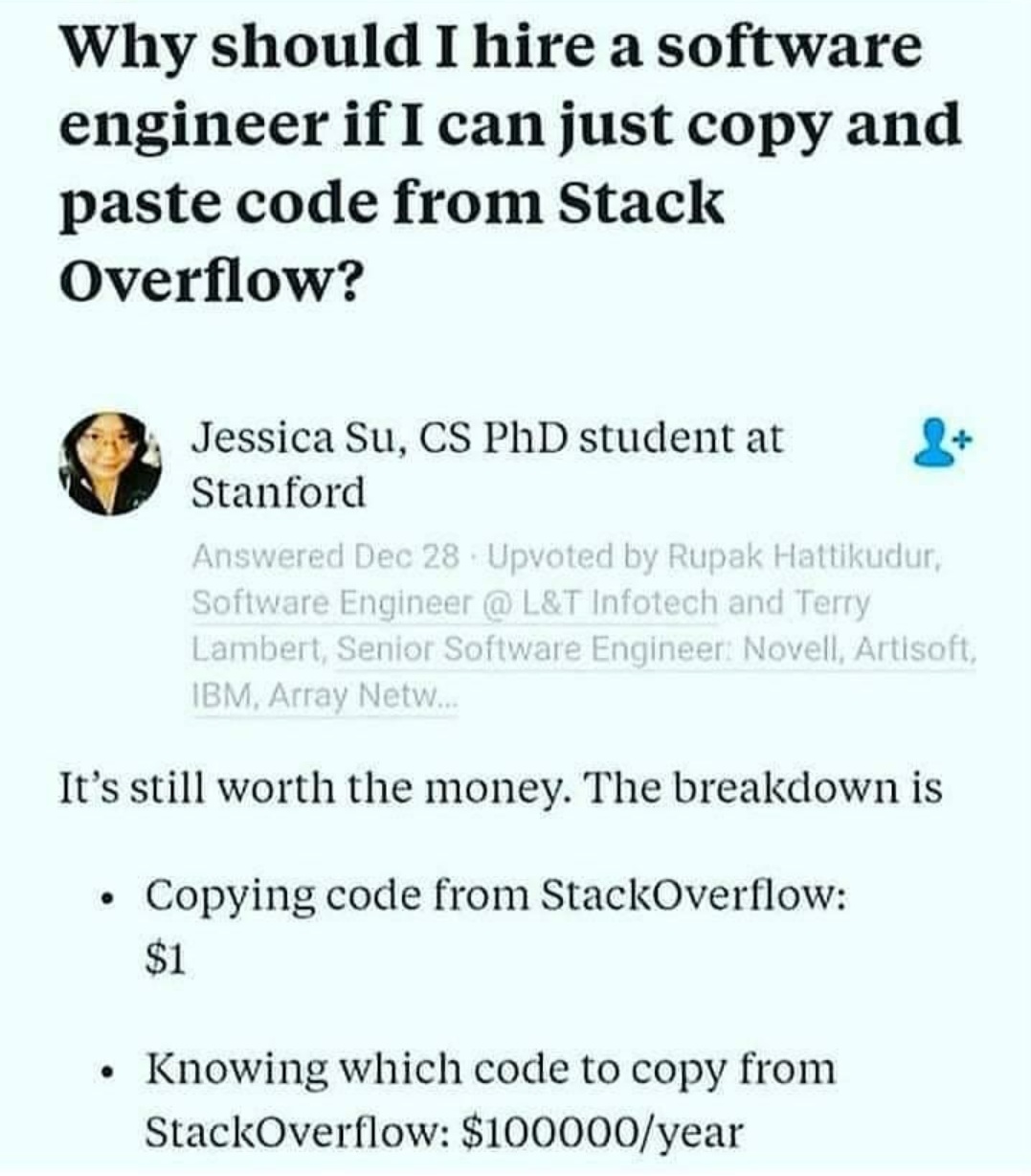
This answer is from 2018, and it keeps being right about different things. When it was written, the joke was about Stack Overflow. Before that, you could've said the same thing about Google. Now you can say it about AI. The technology changes. The misunderstanding doesn't.
When Google became every developer's co-pilot, nobody seriously claimed it would replace engineers. But there was always a quieter version of that idea floating around — the vague sense from the business side that if the answers are all online, what exactly are we paying you for? Stack Overflow made it even more visible. You could literally watch someone copy a function, paste it in, and ship it. How hard could this job really be?
The question in that screenshot is revealing. It's not asked in bad faith. It's asked by someone who genuinely doesn't understand why engineers are expensive, because they think the job is typing code into a file. And honestly, I get it. From the outside, that's what it looks like. We sit at keyboards. Code appears. Things happen. It's a reasonable conclusion if you've never had to debug a race condition or explain to a product manager why "just add a button" is a three-sprint conversation.
Businesses have always thought the hard part is the typing. The actual job — knowing what to build, how it fits together, why one approach survives contact with production and another crumbles — that part is invisible. It doesn't show up in a demo. You can't screenshot it. But it's the reason us more senior engineers exist, and it's the reason that Quora answer has a six-figure punchline.
You're steering. The AI is typing. The division of labor works because you know where you're going.
Now AI is here, and the same pattern is playing out with higher stakes. This time the tool doesn't just find code — it writes it. You can describe what you want in plain English and get back something that looks like a working solution. That's genuinely impressive, and it has genuinely changed how I work. I ship faster. I prototype ideas in minutes that used to take hours. The productivity gain is real.
AI is incredibly productive when you know what you're building. When you understand the system, when you can look at generated code and immediately spot that it's not handling the edge case, or that it's introducing a dependency you don't want, or that the data model is going to fall apart at scale — that's when AI feels like a superpower. You're steering. The AI is typing. The division of labor works because you know where you're going.
When you don't know what you're building? AI is dangerously confident. It will generate plausible-looking code that solves the wrong problem with complete conviction. It doesn't hesitate. It doesn't say "actually, have you considered that this approach won't scale?" It just writes code. Fluently, confidently, and sometimes catastrophically wrong. The gap between "this compiles" and "this is correct" has never been wider.
In my work, AI has become the fastest way to go from a clear idea to working code. But clarity is the prerequisite. Architecture decisions, system design, understanding how a change ripples through a codebase — those are the things I bring. The AI brings speed. That trade works. Remove either side, and you've got problems. The hard part was never the typing.
Engineers who understand systems will always be valuable, regardless of how the code gets written.
I do want to be honest about one thing: if you're a junior engineer right now, this shift is harder on you. The entry-level tasks that used to be learning opportunities — the CRUD endpoints, the form validations, the "wire this API up to the frontend" tickets — are increasingly handled by AI. The rung you were supposed to grab first is getting pulled up. That's a real problem, and anyone who hand-waves it away isn't paying attention.
But the bar shifted. It didn't disappear. The fundamentals matter more than ever, because AI will confidently generate wrong code and someone needs to know enough to catch it. Juniors who learn to work alongside AI — who treat it as a tool to accelerate their understanding rather than a replacement for it — will find their path. It's a different path than the one I took, and I won't pretend that's not frustrating. But the engineers who understand systems will always be valuable, regardless of how the code gets written.
So here's the updated punchline:
Prompting AI to write code: $1.
Knowing whether the AI wrote the right code: $100,000/year.
The tools keep changing. The job stays the same.